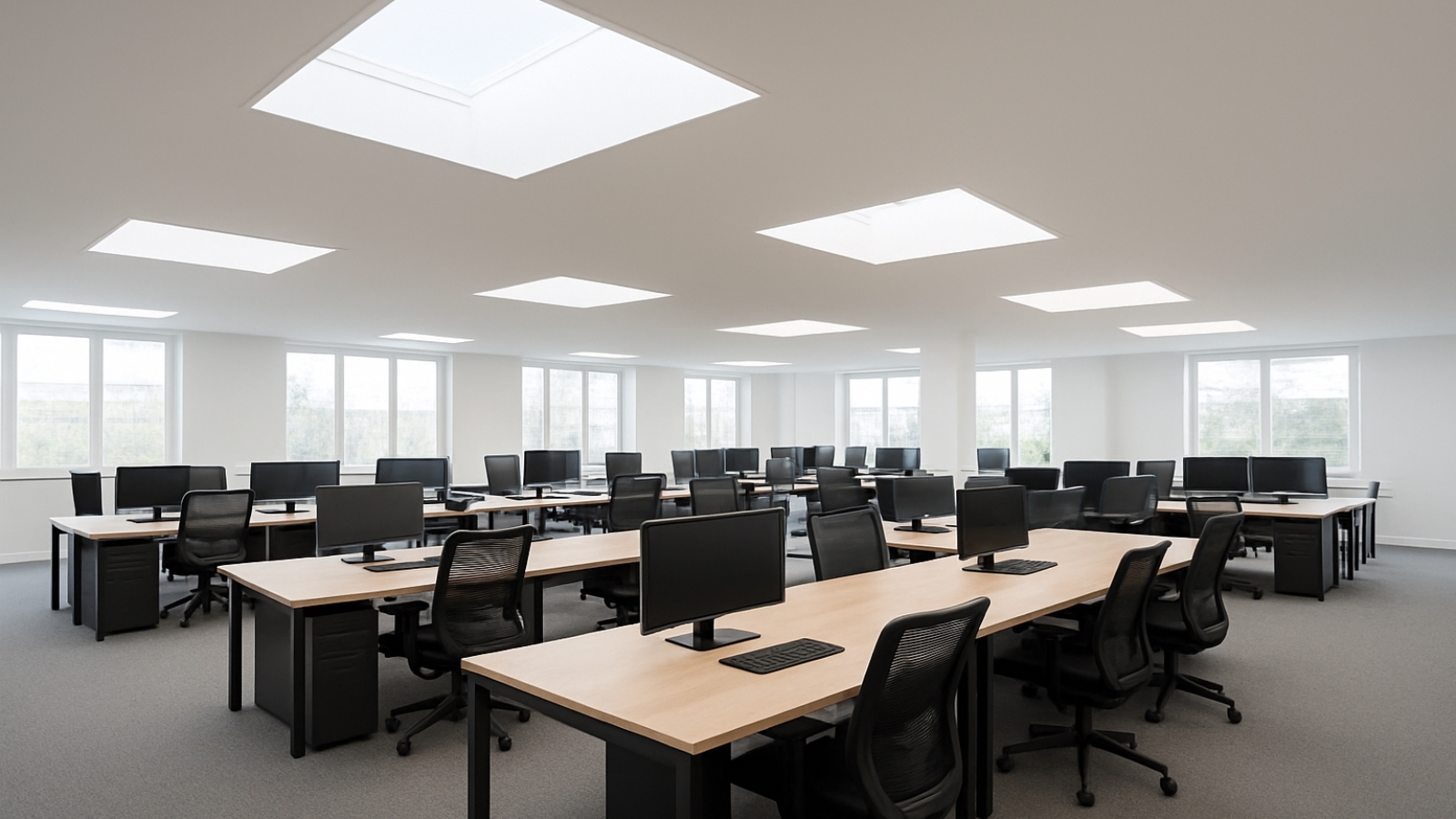
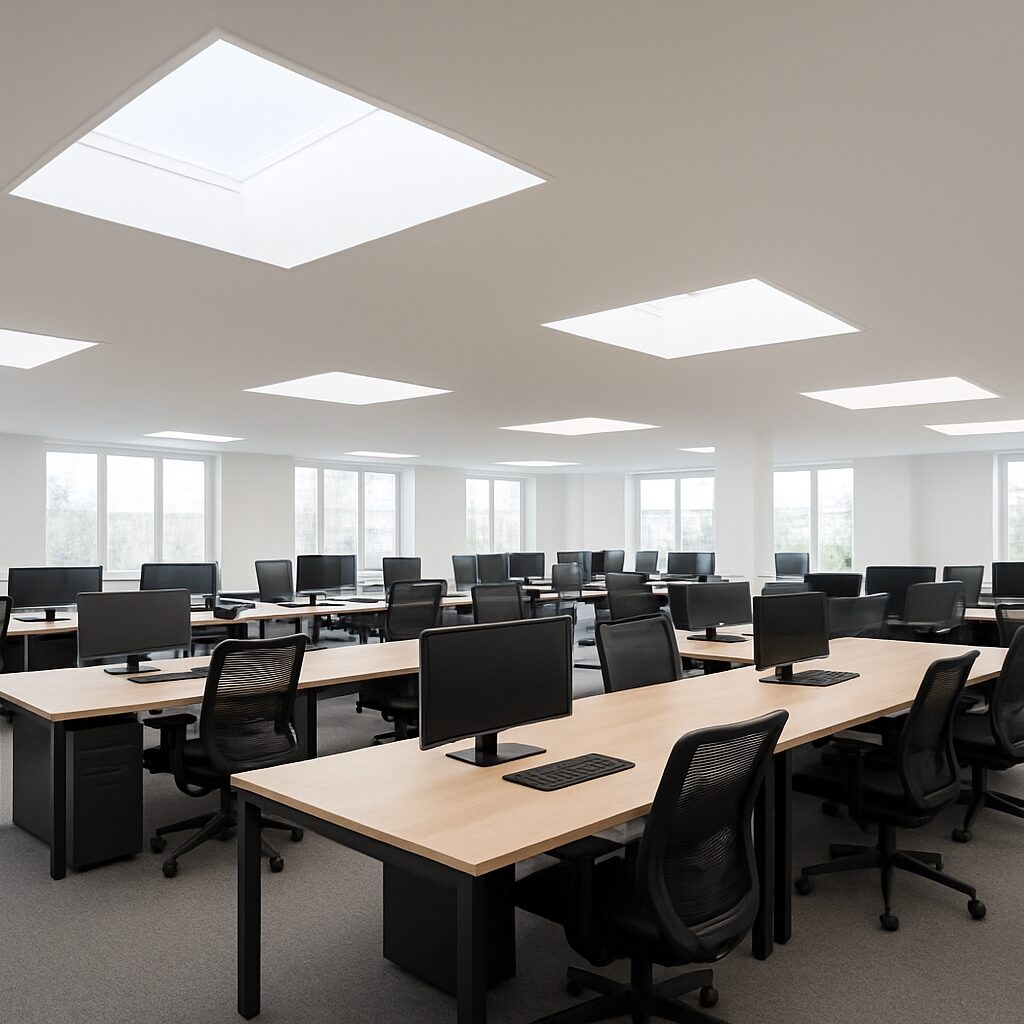
Light shapes how we feel, work, rest, and live. For many indoor spaces — basements, interior offices, retail stores, or rooms with poor natural light — traditional windows or skylights may not always be possible. This is where artificial skylights (also called simulated skylights / virtual skylights / fake skylight) come in: they bring the feeling and benefits of daylight into enclosed spaces, elevating both design and well-being.
In this guide, we’ll explore:
- What exactly an artificial skylight is?
- How these systems are built and operate (the tech)?
- Different types of systems (static, dynamic)
- Key benefits — health, design, energy, and more
- Practical applications — where they make most sense
- Challenges and considerations
- Why are more architects and homeowners choosing them?
Let’s dive in.
1. What Is an Artificial Skylight?
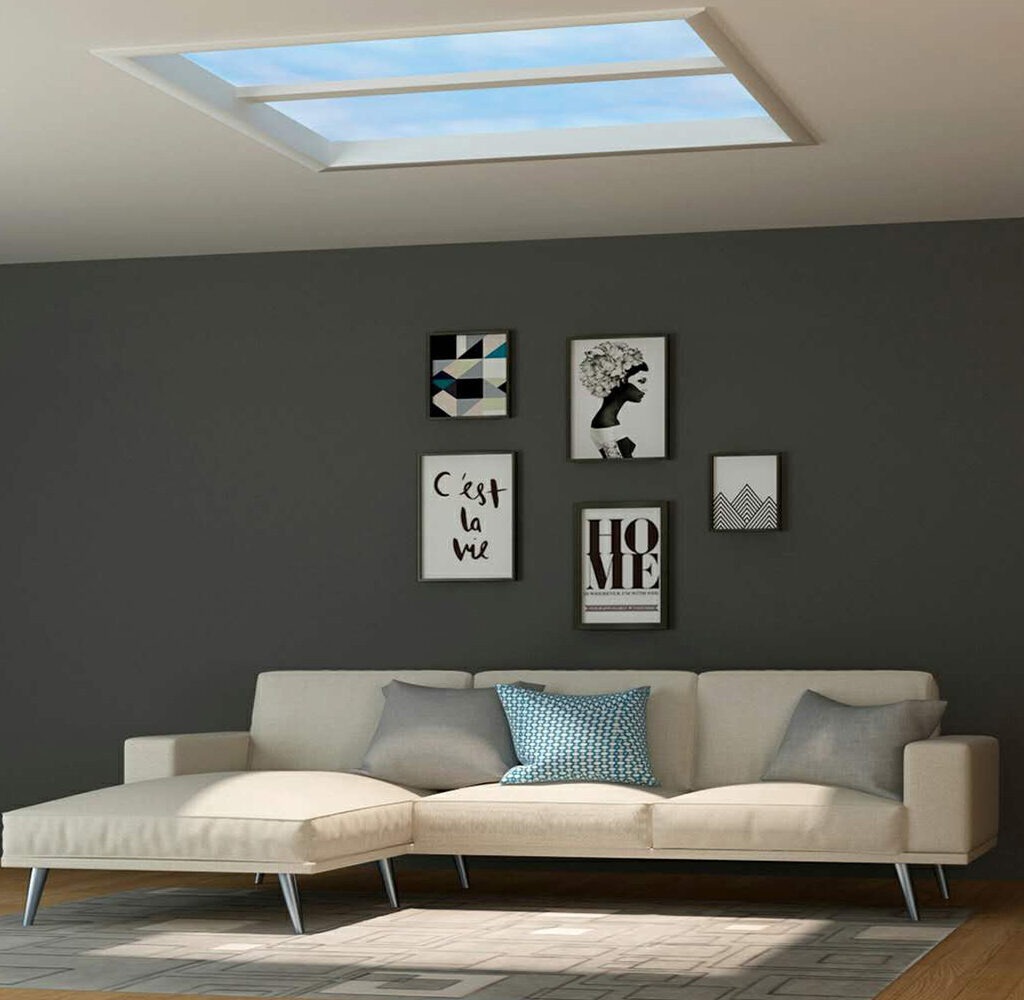
An artificial skylight is a lighting fixture designed to mimic the look and feel of natural daylight coming from the sky — but without having to cut a hole in your roof. Instead of relying on sunlight, these systems use LED-based lighting in combination with optical diffusers, light filters, and sometimes processors that modulate light over time.
Some people also call them simulated skylights, virtual skylights, or Ceiling skylight lights, because they often mount flush into a ceiling or false ceiling grid. Because they’re entirely electrical, they offer huge flexibility: you can install them in basements, windowless rooms, or even on walls.
At their heart, these skylight systems aim to recreate the characteristics of daylight — brightness, color temperature, uniform diffusion — and sometimes mimic how daylight changes over the course of a day. Daylighting experts describe how natural light changes throughout the day in intensity, direction, and spectral quality — principles that artificial skylights are engineered to replicate.
2. How Artificial Skylights Work
To appreciate the magic, it helps to understand how these systems are built and controlled. Here’s a breakdown of how they typically work:
2.1 Core Components
- LED Modules: The backbone of most artificial skylight systems is a high-quality LED array. These LEDs are often “tunable-white,” meaning their color temperature (warm to cool) can be adjusted to simulate different times of day.
- Diffusers & Light Guides: Simply shining LED light upward wouldn’t produce the natural, soft glow of sky light. So, these systems use optimized diffusers (often micro-structured) and light-guiding plates to spread the light evenly, eliminating hotspots and harsh shadows.
- Optical Filters or Lenses: To replicate the subtle quality of daylight, optical filters may be placed in the path of light. These filters tailor the spectral output, adjusting color rendering, saturation, and beam angles.
- Control Electronics: This is where things get powerful. Systems have built-in drivers, dimmers, and controllers that regulate brightness, color temperature, or dynamic effects. These controllers can be:
- Manual: Using a wall switch, remote, or dial
- Smart / Automated: Via an app, or integrated into a building automation system (BMS)
- Dynamic Processors: For systems that simulate moving clouds, sun position, or even a starry night sky.
- Mounting Framework: The panel is usually mounted on the ceiling (or under a false ceiling), either recessed or surface-mounted. Because there’s no need to cut the roof, installation is simpler and less invasive.
2.2 Operating Principles
- Tunable White Lighting: By mixing LEDs of different color temperatures (warm white + cool white), the system can produce different “sky conditions.” For example, morning light might be cooler and brighter, while evening or sunset simulation could lean warm and soft.
- Dynamic Simulation (optional): More advanced systems also simulate motion — clouds drifting across the sky, or even a simulated night sky with stars — using video processing. These systems loop animations or real-time sky visuals and sync them with LED drivers.
- Automation and Timing: Many artificial skylights are programmed to follow a 24-hour light cycle. This means the brightness and color temperature shift throughout the day, replicating the natural progression of sunlight. Alternatively, users can manually override settings.
- Sensor Integration: In some smart systems, ambient light sensors track the actual daylight (if available) and adjust the artificial skylight output accordingly — conserving energy when natural daylight is sufficient, or boosting light when it’s overcast or dark.
3. Types of Artificial Skylights
Not all artificial skylights are the same. Depending on design preference, budget, and function, you’ll typically see two broad categories:
3.1 Static Artificial Skylights
- Definition: These systems produce a steady, uniform light that mimics a fixed daylight condition.
- Advantages: Simpler design, lower cost, easier installation, and fewer control complications.
- Use Cases: Ideal for offices, retail areas, corridors, or any place where a consistent daylight-like glow is needed.
3.2 Dynamic / Animated Artificial Skylights
- Definition: These include a video processor or animation engine, which drives a sequence — like moving clouds, a sun journey, or even a starry sky at night.
- Advantages: High visual realism, immersive feel, stronger biophilic effect, and higher “wow factor.”
- Use Cases: Premium homes, wellness spaces, meditation rooms, spa centers, basements that want to feel open, or luxury lobbies.
4. Why Artificial Skylights Are Needed — Key Benefits
Why should someone invest in an artificial skylight lighting solution (or fake skylight panel) rather than just use regular LED panels or ceiling lights? Here’s why they make sense:
4.1 Psychological & Health Benefits
- Mimicking Natural Daylight: Exposure to daylight has profound effects on mood and mental health. Artificial skylights simulate that effect, helping to replicate some of the psychological benefits of being outdoors.
- Supporting Circadian Rhythm: A good skylight system can be synced to a 24-hour cycle, adjusting light color and intensity to support the body’s natural circadian rhythm. This can help regulate sleep, boost alertness during the day, and reduce fatigue. Experts now agree that indoor lighting should be designed to support the body’s biological clock by aligning color temperature and intensity with natural daylight patterns.
- Increase Productivity & Well-Being: Bright, naturally-tuned light in workspace environments can stimulate productivity. Studies show that better lighting has links to improved focus, creativity, and even fewer errors.
4.2 Design & Architectural Advantages
- Aesthetic Appeal: Artificial skylights add a premium finish to any ceiling. They feel like an architectural element, not just a source of illumination.
- No Structural Changes Required: Unlike traditional skylights, these don’t require cutting the roof or making architectural changes. The ceiling skylight light panel integrates into false ceilings and even the main ceiling seamlessly.
- Flexible Shapes & Sizes: Panels can be custom-made — square, rectangular formations — and fitted into any ceiling grid or ceiling cavity.
4.3 Energy Efficiency & Practicality
- LED Efficiency: Because these systems use LEDs, they consume much less power than many conventional lighting systems while delivering high luminance.
- Smart Controls for Savings: With automated dimming or daylight harvesting (where the system automatically reduces output when natural light is available), you save on power bills.
- Longevity: High-quality LED modules last tens of thousands of hours. When paired with good management, your artificial skylight system can offer years of reliable performance.
4.4 Versatility & Adaptability
- Installation in Windowless Areas: Basements, internal offices, enclosed corridors, and retail interiors are spaces that benefit most. A virtual skylight or simulated skylight gives these spaces a sense of openness.
- Wellness & Healthcare: Spaces like clinics, waiting rooms, or therapy centers benefit strongly from light that feels more natural — boosting patient comfort.
- Residential Applications: For luxury homes, meditative rooms, or simply to elevate interior aesthetics, fake skylight panels add a design statement.
5. Real-World Use Cases
Let’s look at some scenarios where artificial skylight systems shine (pun intended):
5.1 Office Spaces
Imagine a windowless conference room or an interior office cubicle: adding a simulated skylight panel overhead immediately lifts the ambiance. During the morning session, the light could be tuned to a cool, bright tone to maximize alertness. As meetings wind down in the afternoon, the color temperature can warm up, reducing glare and making the space feel more comfortable.
5.2 Healthcare & Wellness Centers
Hospitals, clinics, and therapy centers are increasingly adopting simulated skylights because they can positively influence patient moods and support recovery. A ceiling skylight light that slowly transitions through the day can feel more natural and calming than static fluorescent lighting. In waiting lounges or treatment rooms, a virtual skylight helps reduce stress and provides a therapeutic atmosphere.
5.3 Basements & Interiors in Homes
Basements or windowless interiors often feel claustrophobic and dark. A well-designed LED skylight system on the ceiling can visually “open up” the space, making it feel more airy and welcoming. Coupled with dynamic effects (like gently drifting clouds), you can even simulate a relaxing daytime sky in your very own underground movie room or reading nook.
5.4 Retail & Hospitality Spaces
Flagship stores, luxury boutiques, or hotel lobbies can use artificial daylighting to create a premium customer experience. A virtual skylight adds a sense of drama, elegance, and natural daylight to interiors, making them more inviting and Instagram-friendly.
6. Challenges & Key Considerations
While artificial skylights are powerful, there are some important things to think about before jumping in:
6.1 Initial Cost
These systems are more expensive than standard LED panels. The cost comes not just from LEDs, but from diffusers, controllers, and possibly dynamic-video modules. However, the total cost of ownership can be justified through energy savings, improved well-being, and increased property value.
6.2 Design & Size Constraints
Custom panels or very large skylight installations may require design coordination with architects or ceiling contractors. If using dynamic effects, you’ll need space for the video / processor equipment. The structural design of the ceiling must also be considered.
6.3 Maintenance
Though LED systems are long-lasting, diffusers and optical components need cleaning to maintain uniformity. Control systems may require periodic calibration or firmware updates. Users should plan for occasional maintenance.
6.4 User Adoption
If occupants are used to standard lighting, switching to a simulated skylight — especially a dynamic one — might feel odd at first. There may be a perceptual lag, or users might find the changes subtle (or too strong) until settings are optimized. Proper commissioning and user training are important.
6.5 Energy Management
While energy-efficient, these systems still draw power. If the artificial skylight is set too bright or run continuously without appropriate control, energy consumption might offset some of its savings. Smart control and automation become very important.
7. Why Artificial Skylights Are Becoming More Popular
Given the benefits and flexibility, it’s no surprise that more architects, developers, and homeowners are embracing these systems. Here are some driving factors:
- Urbanization and Windowless Architecture
In high-density developments, many rooms simply don’t have enough external walls or roof access. Artificial skylights solve this by providing a feeling of daylight, even deep inside the building. - Focus on Well-Being & Mental Health
The modern design narrative increasingly values biophilia, or the connection between humans and nature. Simulated daylight helps bring that connection indoors, fostering well-being, comfort, and happiness. - Smart / Human-Centric Lighting Trends
With the rise in circadian lighting and human-centric lighting design, people want more than static illumination. A LED skylight system with tunable white light and automation is a perfect fit. - Energy & Sustainability
As buildings push toward green certifications, efficient lighting that cuts down on energy usage but still delivers quality light becomes very attractive. Artificial skylights tick both boxes. - Experiential Design
Designers want to create not just functional spaces, but emotional ones. Virtual skylights with dynamic effects (cloud motion, sun paths) create memorable, immersive environments.
8. Choosing the Right Artificial Skylight Solution
If you’re considering an artificial skylight for your next project (or renovation), here are some tips to make a smart choice:
- Define Your Goal
- Is your primary need aesthetic (just “make ceiling look like sky”)?
- Or do you want health benefits (support circadian rhythm or well-being)?
- Or both?
- Decide Between Static vs Dynamic
- Static is simpler, more cost-effective, and works great for ambient lighting.
- Dynamic adds realism and a biophilic feel, but has higher complexity and cost.
- Choose Controls
- Do you want manual control (switch, dimmer)?
- Or smart control (app, automation, IoT)?
- Do you need scheduling, ambient light sensing, or syncing with other building systems?
- Panel Size & Placement
- Work with your architect or contractor to design panel sizes that fit your ceiling grid or structure.
- Consider how many panels, their layout, and where they will deliver the most impact.
- Inspect Quality Metrics
- Color Rendering Index (CRI): A higher CRI gives more natural and accurate color.
- Color Temperature Range: Systems that go from cool daylight to warm evening light are more versatile.
- Luminous Output: Check lux (or lumens) to know how bright your panel will be at a given distance.
- Maintenance Planning
- Ask about cleaning schedules for diffusers.
- Confirm how control systems can be updated or serviced.
- Check warranty for both LED modules and control electronics.
- Energy Considerations
- Estimate power usage based on brightness levels, usage hours, and control strategy.
- Use dimming, scheduling, or daylight-harvesting to reduce power consumption when full brightness isn’t needed.
9. Myths & Misconceptions
Here are a few common misunderstandings about artificial skylights — and what the truth usually is:
- Myth: “It’s just a decorative panel, not real light.”
Truth: Modern systems use full-spectrum, tunable white LEDs with high CRI, so the light quality can be very close to natural sunlight. - Myth: “They use a lot of electricity.”
Truth: While they do consume power, efficient LEDs + smart controls (like dimmers or daylight-sensing) significantly reduce energy usage. - Myth: “Installation is difficult & destructive.”
Truth: Because they integrate into ceilings or false ceilings, artificial skylights typically don’t require cutting the roof; they are much less invasive than real skylights. - Myth: “Maintenance will be a hassle.”
Truth: Maintenance needs are quite manageable — LED lifespan is long, diffusers might need occasional cleaning, and control systems are typically reliable.
10. Future of Artificial Skylights
As technology advances, several trends are shaping the future of artificial skylight systems:
- Smarter Integration: Deeper integration with building automation systems (IoT, BMS) allows for predictive lighting control based on occupancy, time of day, or weather.
- Personalized Light: Systems may increasingly use AI or sensors to adapt lighting profiles to individual preferences or biological needs. For example, light could change subtly based on your energy level, mood, or sleep schedule.
- More Realistic Simulation: Future virtual skylights will simulate not just sunlight but dynamic skies, cloud patterns, starfields, even auroras or seasonal changes — making the indoors feel like an extension of the outdoor sky.
- Energy-Positive Lighting: With advances in energy-efficient LEDs and better control strategies, artificial skylight panels could be part of net-zero lighting strategies in smart, green buildings.
- Cost Reduction: As the technology becomes more widespread, the cost of high-fidelity artificial skylight panels will go down, making them more accessible for residential and smaller commercial projects.
Conclusion
Artificial skylights — also known as simulated skylights, virtual skylights, or ceiling skylight lights — are a compelling lighting innovation. They bring the essence of daylight into spaces that otherwise lack natural light, using LED skylight systems and diffusers to replicate not just brightness but a natural, soft sky-like glow.
Their benefits span psychology (improving mood and supporting circadian rhythm), architecture (adding design richness without structural alterations), and sustainability (energy-efficient, smart-controlled lighting). While there are costs and design considerations to keep in mind, the return in terms of well-being, space value, and experiential quality is strong.
For anyone designing or renovating an indoor space that feels dark, enclosed, or disconnected from nature, a fake skylight panel or a full LED skylight lighting solution can be a transformative addition.
If you’re exploring artificial skylights for your next project, Skylicht can help you design, choose, and install the perfect system — combining visual beauty with smart technology to bring the sky indoors.